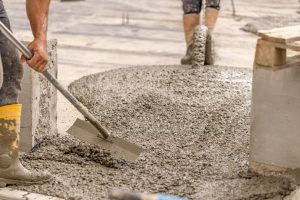
 When using ready mix concrete for foundations, slabs, driveways, commercial floors, or structural construction, making sure the concrete reaches its required strength is critical. Strength directly affects the safety, durability, and long-term performance of a structure, which makes quality control an essential part of every project.
Concrete strength testing on site helps contractors, engineers, and project managers check that the ready mix concrete delivered to site meets the required specification. Whether you are using C20, C25, or higher-strength mixes, testing gives you confidence that the concrete will perform as expected under load.
By measuring compressive strength, construction teams can spot potential issues early, confirm compliance with project requirements, and avoid costly remedial work later. This is especially important for commercial developments, infrastructure projects, foundations, and reinforced concrete structures where strength and consistency are non-negotiable.
This guide explains the most common methods of concrete strength testing on site, how ready mixed concrete is assessed, and why testing plays such an important role in safe and durable construction.
What Is Concrete Strength?
Concrete strength refers to the ability of hardened concrete to withstand loads without failing. The most commonly measured property is compressive strength, which shows how much pressure concrete can take before it crushes.
Concrete grades such as C20, C25, C30, and C40 are classified by their compressive strength after 28 days of curing. For example:
- C20 concrete = 20 MPa compressive strength
- C25 concrete = 25 MPa compressive strength
- C30 concrete = 30 MPa compressive strength
Understanding concrete strength is essential for structural safety and compliance with building regulations.
Why Is Concrete Strength Testing Important?
Testing confirms that:
- The correct concrete mix has been supplied
- The concrete meets design specifications
- Structural safety requirements are achieved
- Quality standards are maintained
- Potential issues are identified early
Without proper testing, there is no reliable way to verify whether concrete will deliver the required performance over its service life.
When Is Concrete Strength Tested?
Strength is typically assessed at several stages during a project:
Fresh concrete testing is carried out immediately after delivery and placement to check workability and consistency.
Early strength testing takes place within the first few days to monitor how strength is developing.
28-day strength testing is the industry-standard benchmark used to confirm whether concrete has achieved its specified design strength.
Common Methods of Concrete Strength Testing on Site
1. Concrete Cube Testing
Cube testing is one of the most widely used methods for assessing compressive strength.
Fresh concrete samples are taken during pouring and placed into standard cube moulds. The cubes are cured under controlled conditions, then tested after set periods, typically at 7 and 28 days. A compression testing machine crushes each cube and records the maximum load.
Cube testing is highly accurate and provides measurable, industry-standard compressive strength results.
2. Slump Testing
Although not a direct strength test, slump testing is routinely carried out on site to check workability and consistency.
A cone-shaped mould is filled with fresh concrete and removed. The amount the concrete settles, known as the slump, is then measured. Consistent slump results often point to consistent water content and batching quality, both of which affect final strength.
3. Rebound Hammer Test
The rebound hammer is a non-destructive method used to estimate surface hardness. A spring-loaded hammer strikes the concrete surface and the rebound distance is measured. Results are fast, there is no damage to the structure, and the method is useful for comparative testing.
The limitation is that it provides estimates rather than exact values, and surface conditions can influence results.
4. Ultrasonic Pulse Velocity Testing
This non-destructive test measures how quickly sound waves travel through concrete to evaluate its quality. It can detect internal defects, assess uniformity, and identify voids and cracks. It is often used alongside other testing methods to build a more complete picture.
5. Core Testing
Core testing is one of the most reliable methods for determining the in-place strength of hardened concrete. A cylindrical sample is drilled from the structure and tested in a laboratory, giving a direct measurement of actual installed concrete.
Core testing is invasive and leaves small holes that need to be repaired, but it produces highly accurate results and is particularly useful when strength concerns have been raised.
Factors That Affect Concrete Strength
Several factors influence how strong concrete becomes:
- Water-to-cement ratio – Too much water significantly reduces strength
- Material quality – The quality of cement, aggregates, and admixtures directly affects performance
- Mixing consistency – Uniform batching helps produce predictable results
- Placement techniques – Poor compaction creates air voids that weaken the concrete
- Curing conditions – Proper curing allows concrete to reach its full design strength
- Weather conditions – Extreme temperatures and rapid moisture loss can hinder strength development
What Happens If Concrete Fails a Strength Test?
If concrete does not achieve its specified strength, further investigation is needed. This may involve additional testing, core sampling, a structural assessment, or an engineering review.
In many cases, low results are linked to poor curing, incorrect batching, excess water, or difficult environmental conditions during placement.
Best Practices for Accurate Concrete Strength Testing
To get reliable results:
- Use accredited testing procedures
- Follow British Standards and industry guidance
- Take representative samples
- Store test specimens correctly
- Maintain accurate records
- Work with experienced concrete suppliers
Consistent testing reduces the risk of costly remedial work and helps ensure compliance throughout the project. The Concrete Centre provides useful guidance on assessing early-age concrete strength on site for those looking to go deeper on testing protocols.
Quality Concrete You Can Trust
At Express Concrete, we supply high-quality ready mix concrete for domestic, commercial, and industrial projects throughout London and the surrounding areas. We have been delivering concrete since 1991 and our QSRMC-accredited supply process means every mix is produced to a verified standard.
Whether you need C20 concrete for foundations, C25 for driveways, or higher-strength mixes for commercial construction, our team can advise on the right product for your project. Combined with proper on-site testing, you can be confident the concrete will perform exactly as required.
Contact Express Concrete today to discuss your requirements or to find out more about our promise to every customer.